If you’ve ever used a food delivery app, checked your bank balance on your phone, or tracked a workout — you’ve used a mobile app. But what actually goes into building one? And why does it matter so much for businesses in 2026?
This guide breaks it all down — from the basic definition to the different types of mobile app development, and how the whole process actually works. Whether you’re a first-time founder or a business owner exploring your digital options, you’ll leave this page with a solid understanding of what mobile app development really means.
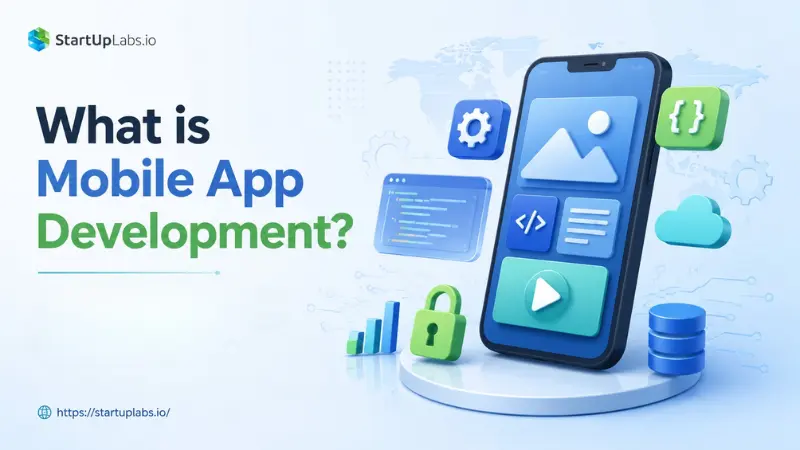
Mobile app development is the process of designing, building, testing, and deploying software applications that run on mobile devices — smartphones, tablets, and wearables. It covers everything from the first spark of an idea all the way through to a live product on the App Store or Google Play, and the ongoing maintenance that follows.
But in 2026, the definition has grown beyond just “writing code for phones.” Today, mobile app development includes UI/UX design, backend infrastructure, API integrations, security architecture, performance optimization, and continuous post-launch improvement. It’s a full product discipline — not just a technical task.
The mobile app economy reflects this. The global mobile application market is projected to reach USD 626.39 billion by 2030, growing at a CAGR of 14.3% from 2024 to 2030. For businesses, this isn’t just a statistic — it’s a signal. Companies without a mobile presence are already falling behind in industries where competitors have been mobile-first for years.
If you want to understand the full scope of building an app — costs, timelines, tech stacks, and strategy — our Complete Guide to Mobile App Development in 2026 covers all of it in one place.
Not all mobile apps are built the same way. Before a single line of code gets written, one of the most important decisions a business makes is what kind of app to build. Each approach comes with its own tradeoffs on cost, speed, performance, and reach.
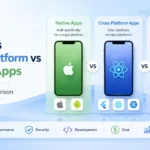
Native mobile app development means building an app specifically for one platform — either iOS using Swift and SwiftUI, or Android using Kotlin and Jetpack Compose. Because native apps are written for a single platform, they deliver the best performance, the smoothest animations, and the deepest integration with device features like the camera, GPS, and biometrics.
The tradeoff? You’re essentially building two separate apps if you want to cover both iOS and Android. That means more time and more budget. For apps where performance is a top priority — like gaming, fintech, or health monitoring — native is often worth it. Explore our iOS App Development and Android App Development services to understand what goes into building platform-specific applications.
Cross-platform mobile app development lets you write one codebase and deploy it across both iOS and Android. Frameworks like Flutter and React Native dominate this space in 2026. Flutter in particular has matured significantly — its fast rendering engine and rich component library allow for near-native performance at a fraction of the cost of building two separate native apps.
For most startups and businesses launching their first app, cross-platform is the smart choice. It cuts development time, reduces cost, and still delivers a high-quality experience. Our Cross-Platform App Development Services are built around Flutter and React Native for exactly this reason.
Hybrid apps use web technologies — HTML, CSS, and JavaScript — wrapped inside a native shell. They’re quicker to build initially and easier to maintain if your team has web development experience. Hybrid apps combine elements of web and native development, running inside a native container which allows them to be distributed via app stores while keeping development efficient.
That said, hybrid apps can struggle with performance on complex interactions and often feel slightly less polished than their native or cross-platform counterparts. They work well for simpler apps or internal business tools where raw performance isn’t the primary concern.
Custom mobile app development means building an app from scratch, specifically designed around your business’s unique requirements — rather than adapting a generic, off-the-shelf solution.
The difference matters more than most people initially realize. A pre-built app template might get you live faster, but it’ll also box you in — limited integrations, someone else’s feature roadmap, and no real ownership of the product. A custom-built app, on the other hand, is designed around your users, your workflows, and your growth plans.
Custom development is the right choice when your product has unique logic that no existing tool can replicate, when you need full control over data and security, or when the app is core to your business model rather than a peripheral feature. Most of the apps StartUpLabs builds through our Mobile App Development Services are fully custom — because that’s what businesses that are serious about growth actually need.
Enterprise mobile app development refers to building applications that serve the internal or external needs of large organizations — think field service tools, employee portals, logistics platforms, customer-facing apps for large user bases, or systems that integrate deeply with existing infrastructure like CRMs and ERPs.
Enterprise apps are built to support business workflows, employees, partners, or large customer bases. They usually require deeper security, role-based access, audit logs, and integrations with systems like CRM and ERP — while consumer apps focus more on broad usability and growth.
This distinction is important. Enterprise apps have to meet far stricter standards around security, compliance, uptime, and scalability. A consumer app that goes down for an hour is annoying. An enterprise app that goes down for an hour can halt operations and cost significant money.
If you’re looking for an experienced enterprise mobile app development company, the right partner should have a proven track record with complex integrations, regulatory compliance, and post-launch support built into their process. Our Mobile App Development Services team works with enterprises across industries including fintech, healthcare, and logistics.
MVP stands for Minimum Viable Product. In mobile app development, an MVP is the first working version of your app that includes only the core features needed to solve the main problem — and nothing else.
An MVP is the first functional version of your app that focuses on solving one main problem and delivering clear value to early adopters. Unlike a demo or prototype, it’s a real, usable product that can be released to actual users to gather real-world feedback before you invest in the full build.
The logic is simple. Rather than spending 12 months and a large budget building everything you think users want, you spend 3–4 months building what they need — and then use what you learn from real users to guide every decision after that. Instagram, Uber, and Dropbox all started as MVPs. They weren’t perfect. But they solved a real problem, attracted real users, and improved from there.
For startups especially, starting with an MVP is almost always the smarter financial and strategic move. Our upcoming guide on MVP in Mobile App Development for Startups breaks down exactly how to scope, build, and launch your MVP the right way.
When a business hires a mobile app development company, what exactly are they paying for? This is a question worth answering clearly, because “app development services” can mean very different things depending on who you ask.
A full-service mobile app development partner — like StartUpLabs — typically covers the entire product lifecycle. That includes discovery and strategy (defining what to build and why), UI/UX design (wireframes, prototypes, and visual design), frontend and backend development, QA and Mobile App Testing Services, deployment to the App Store and Google Play, and ongoing post-launch maintenance.
Some agencies only handle development and hand the project off after launch. Others, like us, stay involved through the full lifecycle because we know that launching is just the beginning — the real work of improving, scaling, and maintaining an app happens after it’s live.
Understanding the what of mobile app development is one thing. Knowing how it actually unfolds as a project is equally important — especially if you’re planning to commission an app for the first time.
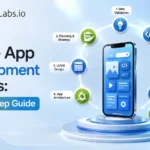
At a high level, the process looks like this:
Mobile app development is much more than writing code—it’s the process of transforming ideas into secure, scalable, and user-friendly digital products that solve real-world problems. From choosing between native, cross-platform, and hybrid development to understanding concepts like MVPs, enterprise applications, and custom solutions, every decision influences your app’s performance, user experience, and long-term success.
Whether you’re a startup validating a new idea or an established business looking to expand your digital presence, understanding the fundamentals of mobile app development helps you make informed technology and investment decisions. As mobile technology continues to evolve in 2026 with AI-powered features, cloud integration, and advanced user experiences, businesses that adopt the right development strategy will be better positioned to stay competitive and meet changing customer expectations.
If you’re planning to build a mobile application, taking the time to define your goals, choose the right technology stack, and follow a structured development process can significantly improve your chances of success. And if you need expert guidance, the team at StartUpLabs can help you transform your concept into a high-quality mobile application with end-to-end development, testing, deployment, and ongoing support tailored to your business goals.
Ans: Mobile app development is the process of creating software applications that run on smartphones, tablets, and wearable devices. It covers everything from design and coding to testing and launching on platforms like the App Store and Google Play.
Ans: The three main types are native (built separately for iOS or Android), cross-platform (one codebase for both platforms using frameworks like Flutter or React Native), and hybrid (web technologies wrapped in a native shell). Each has different tradeoffs on performance, cost, and development speed.
Ans: Custom mobile apps are built from scratch to meet your specific business needs, giving you full ownership and flexibility. Off-the-shelf apps are pre-built solutions that can be deployed faster but come with limitations on features, integrations, and scalability.
Ans: An MVP (Minimum Viable Product) is the first working version of your app with only the essential features needed to validate your idea with real users. It’s a strategy to reduce risk, cut initial costs, and learn from real user behavior before investing in the full build.
Ans: A full-service mobile app development company handles the complete product lifecycle — strategy and discovery, UI/UX design, frontend and backend development, quality assurance testing, App Store deployment, and ongoing post-launch support and maintenance.

The StartUpLabs Team consists of technology and digital marketing experts passionate about helping businesses grow. We share industry insights and best practices in software development, AI, web and mobile solutions, and digital marketing.

Get Quote Now
Recent Post