The world of online search is going through a massive change. Google is shifting from a standard search engine that simply finds links to an AI-powered ecosystem that actually does things for you.
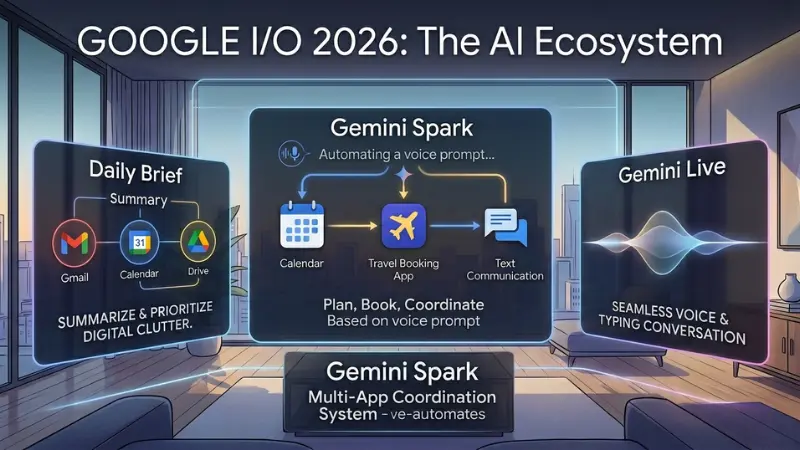
Google’s newest updates show a clear move toward automated, always-on AI assistants. The four major highlights include:
The search landscape is shifting from traditional SEO (Search Engine Optimization) to GEO (Generative Engine Optimization) or AIO (AI Optimization). This shift brings three new realities:
The “Zero-Click” Reality is Expanding
Because Gemini can summarize text, build daily briefs, and handle tasks natively through features like Spark, users will have fewer reasons to click through to standard websites. If Google can answer a question or complete a task inside its own interface, the user stays there.
Conversational Long-Tail Keywords
Because of Gemini Live, people will search using highly conversational, complex, spoken phrases rather than typing rigid keywords.
The Shift in Action: Instead of typing “best running shoes flat feet,” a user will say, “Hey Gemini, I have flat feet and my knees hurt when I run marathons, what shoes should I get?”
AI-Generated Context
Your website’s content won’t just be ranked by a standard index anymore. It will be scanned by Gemini to see if it can be used to feed a user’s Daily Brief or help an AI agent complete a specific task.
If you already have good search rankings, you are in a great position. However, you must protect them by proving to Google that a human expert – not just a generic AI – wrote your content. You can do this by focusing on four core strategies:
1. Double Down on E-E-A-T
E-E-A-T stands for Experience, Expertise, Authoritativeness, and Trustworthiness. AI can copy and combine information, but it cannot physically experience things. Inject first-hand experience, original case studies, unique data, and quotes from real human experts into your content. This makes your content irreplaceable by AI.
2. Update and Refresh Your Top-Performing Content
Look closely at the pages bringing you the most traffic right now. Make sure they are completely up-to-date, fast-loading, and thoroughly answer the user’s intent. If your content sits stale, an AI-generated summary will easily replace the need for it.
3. Build a Direct Brand Audience
Since search traffic might fluctuate as AI agents take over basic queries, you need to own your audience directly. Drive your current search traffic to sign up for an email newsletter, follow your social media channels, or bookmark your site so they can find you without relying on a search engine.
4. Focus on Brand Mentions (Digital PR)
Gemini learns what brands are trusted by looking at what the rest of the web says about them. Get your brand mentioned, reviewed, and linked to from other authoritative, niche-specific websites. The more Gemini sees your name associated with a topic across the web, the more it will recommend you in AI responses.
With AI answering so many questions directly, many business owners wonder if SEO is still worth the effort. The answer is yes, but the way you get results is shifting.
Previously, SEO was about getting thousands of clicks from people asking top-of-funnel, general questions (like “What is digital marketing?”).
If Gemini summarizes your blog post and displays it on the search page, how do you make money? You have to optimize for Assisted Conversions and Brand Footprints:
If you stop doing SEO, your brand completely disappears from the AI’s memory bank.
AI models like Gemini do not invent information out of thin air; they scrape and synthesize the live web. SEO is no longer just about optimizing for human eyes first; it is about optimizing so that Google’s AI model understands and trusts your business enough to recommend it.
If you abandon SEO:
Instead of chasing raw traffic numbers, your SEO strategy must pivot from the old way of doing things to the new GEO style:
Old SEO Playbook | New GEO Playbook |
Focus on high-volume, short keywords. | Focus on conversational phrases and high-buyer-intent questions. |
Writing 2,000-word generic articles to rank #1. | Writing highly accurate, data-rich “answer blocks” that Gemini can cite. |
Measuring success purely by Clicks & Impressions. | Measuring success by Brand Mentions in AI, Share of Voice, and Conversion Rates. |
Traditional SEO relies heavily on keywords and page-level ranking factors like backlinks. AEO (Answer Engine Optimization) and GEO (Generative Engine Optimization) rely on a process called Semantic RAG (Retrieval-Augmented Generation).
When a user types a prompt into an AI engine, the system processes it in three millisecond-long steps:
[User Input Prompt]
│
▼
1. Query Embedding ──► AI converts natural language into a mathematical vector (concept meaning).
│
▼
2. Semantic RAG ────► AI searches databases & the live web for 100-300 word relevant text “chunks”.
│
▼
3. Generation ──────► LLM reads top 10-50 chunks, writes a smooth answer, and adds citation links.
The Goal of GEO: You aren’t trying to rank #1 anymore. You are trying to be the most extractable and trustworthy source chunk so the AI uses your data to construct its answer and cites your URL.
AI engines don’t index websites the old way by scraping entire pages and counting keywords. They process sites through Chunking, Vector Embeddings, and Cross-Web Validation:
Beyond standard FAQs and basic schema code, a website trying to dominate the AI search landscape requires these specific advanced components:
The llms.txt File
Just like a robots.txt file directs traditional search crawlers, an llms.txt file acts as a clean markdown summary explicitly written for AI models. You place this file in your root directory so AI models can rapidly understand your site layout, key offerings, and core data.
“Front-Loaded” Data Density (The 30% Rule)
Recent data shows that over 44% of all LLM citations come from the first 30% of a web page. You must stop using long, conversational fluff introductions. State your primary answer, statistics, or product data in the very first paragraph.
Original Entity Attributes (Data Hunger)
AI engines crave new data to learn from. Your pages must feature proprietary statistics, original case studies, or native calculator tools. If your article is just a copy of 10 other blogs, the AI’s similarity scoring recognizes you have nothing new to offer and ignores you.
Clear Semantic HTML Formatting
AI extracts data from structured code. Use precise HTML tags like <table> for specifications, <ol> for step-by-step guides, and <blockquote> for expert quotes. If your data is trapped in an unreadable image or a messy layout, the AI passes it by.
ChatGPT operates in two distinct states: Training Data Mode (answering from its internal memory) and Search Mode (browsing the live web). Its search feature relies heavily on Bing’s live search index for real-time results. Approximately 87% of ChatGPT’s external citations directly overlap with top results on Bing.
Gemini is deeply integrated with Google’s massive, pre-existing proprietary datasets – specifically the Google Knowledge Graph and the Google Shopping Graph. Unlike standalone chatbots, Gemini heavily validates web data against real-world entities it already knows to be true, and relies on strict machine-learning quality filters.
Perplexity brands itself as a “Truth and Discovery Engine.” It acts like a real-time researcher that digs into the web to find consensus, data, and citations. It has a massive bias toward Freshness, Citations, and Community Consensus Platforms (like Reddit, Quora, and YouTube).
Search is changing fast, and businesses need to adapt to stay visible online. In 2026, success is no longer just about ranking high on Google. It is about creating valuable, trustworthy content that both people and AI-powered search engines can understand and recommend. By focusing on expertise, real-world experience, strong brand authority, and well-structured content, businesses can increase their chances of being featured in AI-generated answers and search results.
The shift from traditional SEO to GEO and AEO does not mean SEO is dead—it means SEO is evolving. Brands that invest in quality content, user trust, and AI-friendly optimization will continue to attract high-intent visitors and generate meaningful results. As the digital landscape becomes more AI-driven, companies like StartupLabs understand the importance of building content and online experiences that are useful, credible, and ready for the future of search.
Ans: No, but they work differently. AI no longer matches exact words character-for-character. Instead, it uses Vector Embeddings to understand the deeper meaning and intent behind a query. You still need industry terms, but you must focus on covering a topic thoroughly rather than repeating a single phrase.
Ans: Features like Gemini Live mean users talk naturally instead of typing rigid text. Instead of searching “best running shoes flat feet,” a user will say, “Hey Gemini, I have flat feet and my knees hurt when I run marathons, what shoes should I get?” Your content must adapt to these conversational, long-tail phrases.
Ans: Yes. High-security settings – such as Cloudflare’s Automated Bot Fight Mode – often treat AI scrapers as malicious threats. If left on maximum security without adjustments, your firewall will block these bots, causing your website to completely disappear from AI summaries and citations.
Ans: No, you need to separate them. You can safely block AI Training Bots (like GPTBot) if you want to protect your intellectual property. However, you must explicitly allow AI Search Crawlers (like PerplexityBot and ChatGPT-User), because they fetch real-time data to answer live user questions.
Ans: Data shows that over 44% of all AI citations come from the very first 30% of a webpage. To rank in AI search, you must stop using long, conversational fluff introductions. Implement the BLUF (Bottom Line Up Front) style: place your most important answer, key statistics, or product data in the absolute first paragraph under your headings so the AI crawler can easily extract it.
Ans: Yes, it is highly recommended. Just like a robots.txt file tells traditional search engines which pages to crawl, an llms.txt file is a clean markdown file placed in your website’s root directory that acts as a highly structured summary specifically for AI models to rapidly understand your site layout, key services, and core data.
Ans: Many modern websites use heavy JavaScript to load text dynamically as a user scrolls. While standard Google bots can read this, heavy AI scraping bots often skip complex scripts to save processing power. If your core text disappears when JavaScript is turned off, you must switch to Server-Side Rendering (SSR) so the raw HTML is visible instantly to the AI scraper.

Jai has over 14 years of experience consulting startups, agencies and small to mid market companies across the globe (United States, Australia, Canada) and executing their projects. He holds a Bachelor degree in Computer Science from VIT Vellore. He has solid expertise handling projects at various stages, scales, in different roles and spanning over several industry verticals.
Get Quote Now
Recent Post