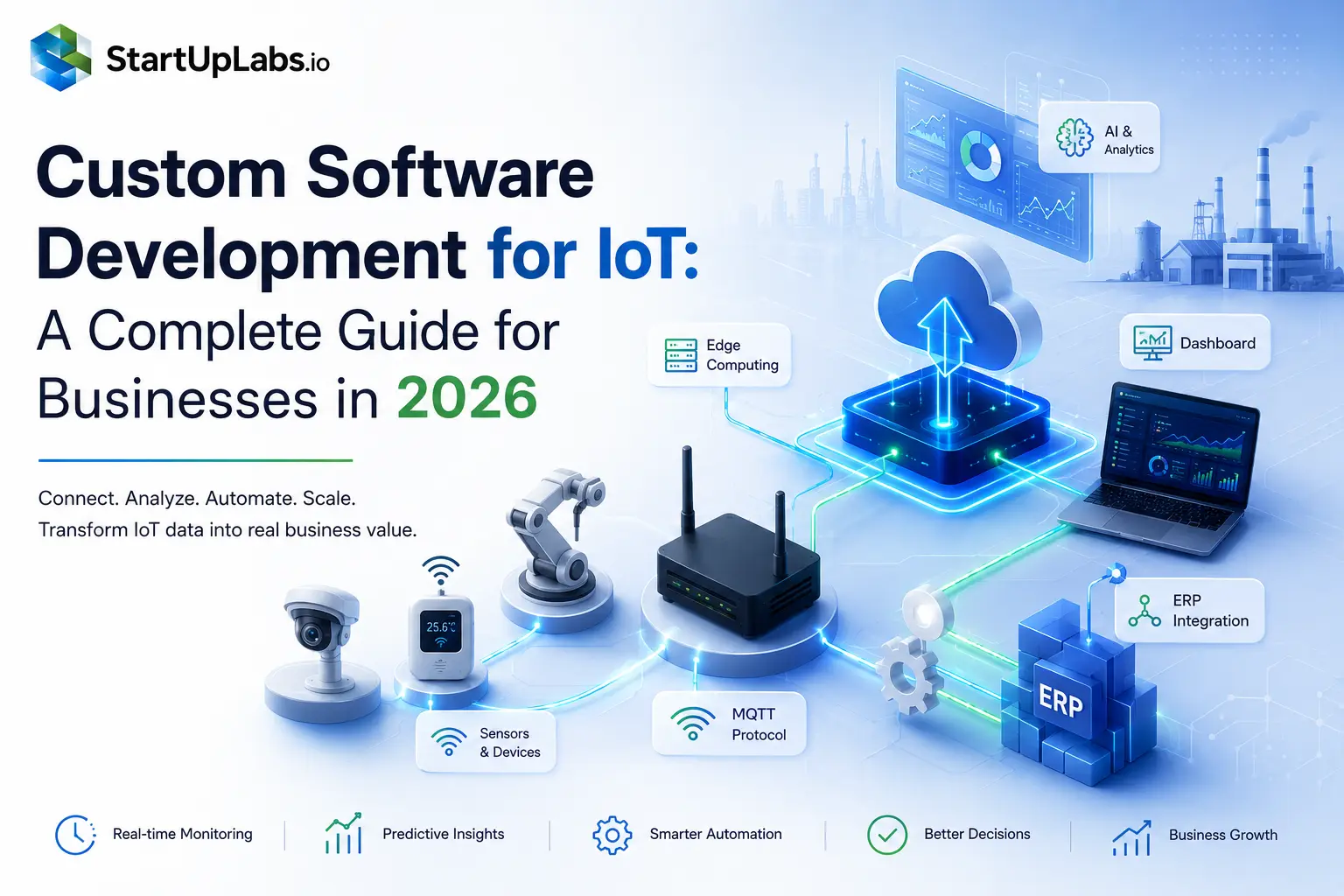
The Internet of Things (IoT) is no longer limited to connecting sensors and collecting device data. Businesses are using connected devices, edge computing, cloud platforms, artificial intelligence, and custom software to monitor operations, automate workflows, predict failures, improve customer experiences, and create connected products.
However, connecting thousands of devices is only one part of an IoT strategy. The real business value comes from the software layer that collects, processes, secures, analyzes, and turns device data into actionable information.
Custom software development for IoT involves building software specifically around a company’s devices, workflows, data requirements, integrations, security needs, and business objectives. Unlike generic IoT platforms, custom solutions can be designed around the exact way an organization operates.
This guide explains how custom IoT software works, its architecture, development process, technology stack, security considerations, costs, scalability challenges, AI integration, and how businesses can decide whether to build a custom solution or use an existing IoT platform.
Custom IoT software development is the process of designing and building software specifically for an organization’s connected devices, sensors, applications, data infrastructure, and operational requirements.
A custom IoT solution can include several software layers, such as:
The objective is not simply to collect data from connected devices. It is to create a complete system that transforms raw device data into useful business actions.
For example, consider a manufacturing company with hundreds of machines.
A basic IoT deployment might collect machine temperature and vibration data.
A custom IoT platform can go further:
Machine Sensor → Edge Gateway → MQTT → IoT Platform → Data Processing → Time-Series Database → AI Model → Alert → Maintenance Workflow → ERP
If the system detects an abnormal vibration pattern, it can identify a potential machine problem, notify the maintenance team, create a service ticket, and record the event in the company’s maintenance system.
That is where custom software turns IoT connectivity into an operational system.
Traditional business software generally works with data entered or generated by people and business applications.
IoT software has an additional data source: physical devices.
These devices continuously generate information such as:
IoT software therefore needs to handle characteristics that are less common in conventional applications:
This makes IoT software architecture fundamentally different from a standard web application.
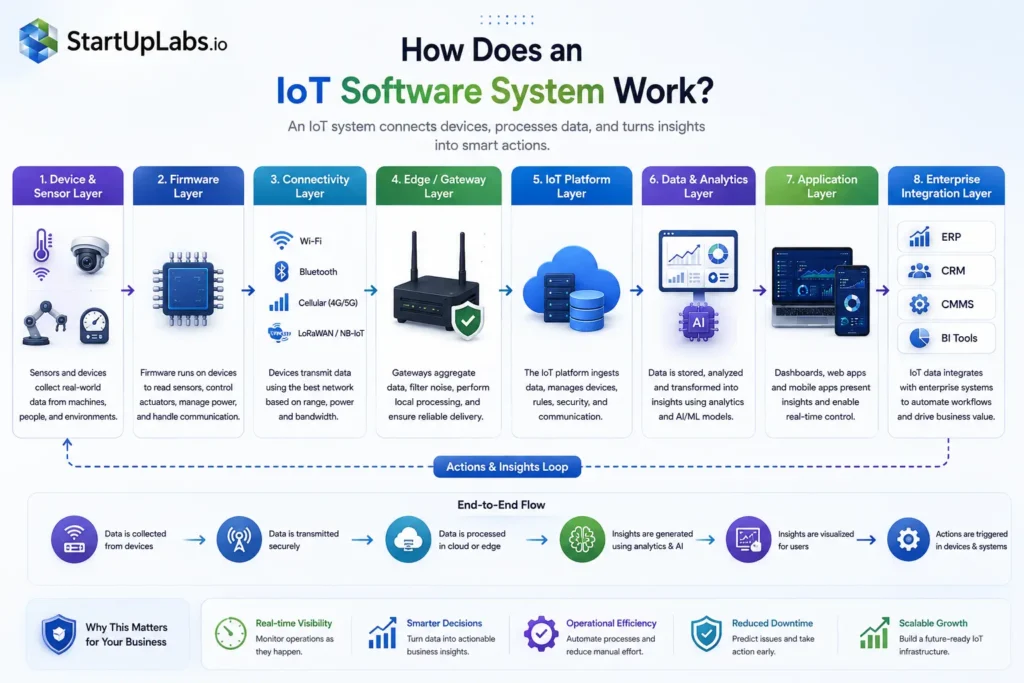
A complete IoT system normally contains multiple interconnected layers.
A simplified architecture looks like this:
Sensors & Devices → Firmware → Connectivity → Gateway/Edge → IoT Platform → Data Processing → Database → Analytics/AI → Application → Business Systems
Each layer performs a different role.
The physical layer contains sensors, actuators, machines, wearables, vehicles, meters, cameras, or other connected equipment.
Sensors can measure physical conditions such as:
Actuators allow software to influence the physical environment.
For example, software might instruct a connected device to:
Firmware controls how an embedded device interacts with its hardware.
It may manage:
For battery-powered devices, firmware design can have a major impact on battery life.
Devices need a communication mechanism to transmit data.
Depending on the use case, connectivity may include:
The appropriate technology depends on range, bandwidth, power consumption, latency, deployment environment, and cost.
An IoT gateway can act as an intermediary between devices and cloud infrastructure.
Edge processing can be useful when data needs to be analyzed close to the device.
For example, a manufacturing system may detect a dangerous machine condition locally instead of sending every raw sensor reading to the cloud before taking action.
Edge computing can reduce latency and network traffic, while cloud infrastructure remains useful for centralized storage, analytics, orchestration, and long-term data processing.
The IoT platform can provide capabilities such as:
IoT systems can generate significant amounts of time-series data.
This layer may include:
The objective is to transform raw telemetry into useful information.
The application provides an interface for users.
It may be:
Finally, IoT software may connect with existing business applications through APIs and integration services.
For example:
IoT Platform → API → ERP → Maintenance Order
This is often where IoT data becomes operationally useful.
There is no single type of IoT application. The software architecture depends heavily on the business use case.
IoT Device Management Software
Used to register, configure, monitor, update, and manage large numbers of connected devices.
IoT Monitoring and Control Platforms
These platforms provide real-time visibility into devices and allow authorized users to control connected equipment.
Industrial IoT Software
Industrial IoT systems can monitor:
These systems transform large volumes of telemetry into reports, dashboards, trends, and operational insights.
Predictive Maintenance Software
Predictive maintenance systems analyze equipment behavior to identify patterns associated with potential failures.
Asset Tracking Platforms
These solutions can track the location, status, and movement of physical assets.
Smart Building Management Software
IoT software can integrate:
Manufacturers can use IoT software to create connected products that communicate with cloud systems and mobile applications.
Remote Monitoring Applications
These applications allow users to monitor assets or environments without physically being present.
Digital Twin Platforms
A digital twin represents a physical object, machine, facility, or process digitally and continuously updates its state using real-world data.
Manufacturers can use IoT software for:
For example, vibration and temperature sensors can continuously monitor machinery and provide early indications of abnormal conditions.
IoT software can support:
Healthcare implementations require careful attention to security, privacy, regulatory requirements, and the reliability of connected systems.
IoT platforms can provide:
For temperature-sensitive products, connected sensors can continuously monitor environmental conditions during transportation.
Retail IoT applications can include:
IoT software can collect information from:
The resulting data can help farmers make more informed decisions about irrigation, crop conditions, and resource usage.
IoT systems can support:
Connected vehicle platforms can provide:
IoT software can coordinate building systems such as:
A useful IoT platform should be designed around the operational requirements of the business.
Real-Time Dashboards
Dashboards provide visibility into device status, sensor readings, alerts, and operational metrics.
Device Provisioning
Provisioning allows new devices to be securely registered and configured.
Remote Device Management
Administrators may need to:
OTA Firmware Updates
Over-the-air updates allow software and firmware to be updated remotely.
A robust OTA system should consider:
Alerts and Notifications
Alerts can be triggered when data crosses predefined thresholds or when abnormal behavior is detected.
Notifications can be delivered through:
Data Visualization
IoT dashboards can visualize:
Role-Based Access Control
Different users may need different permissions.
For example:
Administrator → Operations Manager → Technician → Viewer
API Integrations
APIs allow IoT software to communicate with other systems.
AI-Powered Analytics
Machine learning can help identify anomalies, predict failures, classify events, and generate forecasts.
Audit Logs and Reporting
Enterprise IoT platforms often need detailed records of:
Communication protocols determine how devices and systems exchange information.
MQTT is a lightweight publish-subscribe messaging protocol commonly used in IoT environments.
It can be suitable when devices have limited bandwidth or intermittent network connectivity.
CoAP is designed for constrained devices and networks.
It can be useful in applications where devices have limited processing power, memory, or energy.
HTTP is widely understood and works well for web-based APIs and systems where its overhead is acceptable.
HTTPS should be used when secure HTTP communication is required.
WebSockets provide persistent, two-way communication between clients and servers and can be useful for real-time dashboards and applications.
AMQP is designed for message-oriented communication and can be appropriate for enterprise messaging scenarios.
OPC UA is widely associated with industrial automation and machine-to-machine communication.
The right protocol depends on device constraints, network conditions, message patterns, interoperability requirements, and the surrounding architecture.
Connectivity should be selected based on the physical and operational environment rather than simply choosing the newest technology.
| Technology | Typical Strength | Important Consideration |
|---|---|---|
| Wi-Fi | High bandwidth | Power consumption and range |
| BLE | Low-power local communication | Shorter range |
| 4G/5G | Wide-area connectivity | Network and operating cost |
| LoRaWAN | Long range and low power | Low bandwidth |
| NB-IoT | Low-power cellular IoT | Carrier availability |
| Zigbee | Low-power mesh networking | Ecosystem compatibility |
| Thread | Low-power IP-based mesh | Device ecosystem |
When selecting connectivity, evaluate:
The best IoT technology stack depends on the device, scale, latency requirements, data model, cloud environment, and development team’s expertise.
Common choices include:
C and C++ remain widely used in embedded environments, while Rust is increasingly considered for systems where memory safety is an important design objective.
Potential options include:
Backend services can be built using technologies such as:
Major cloud ecosystems provide IoT-related infrastructure and services, including:
The specific services should be selected according to device scale, data architecture, integration requirements, security model, and existing cloud strategy.
Different IoT workloads may require different database technologies.
Potential choices include:
Time-series workloads often benefit from databases and storage architectures optimized for timestamped telemetry.
IoT platforms often require Web Application Development for real-time dashboards, device management portals, analytics interfaces, and administrative systems.
Common frontend technologies include:
Mobile App Development is often an important part of IoT platforms when users need remote monitoring, device controls, alerts, and real-time operational data.:
Python is commonly used for:
Frameworks such as TensorFlow and PyTorch can support machine learning workflows depending on project requirements.
Identify the business problem, target users, connected devices, required data, workflows, integrations, and expected outcomes. Start with the business objective rather than selecting technology first.
Plan the complete architecture from sensors and devices to the final business application. Define the device, edge, connectivity, cloud, database, AI, dashboard, and enterprise integration layers.
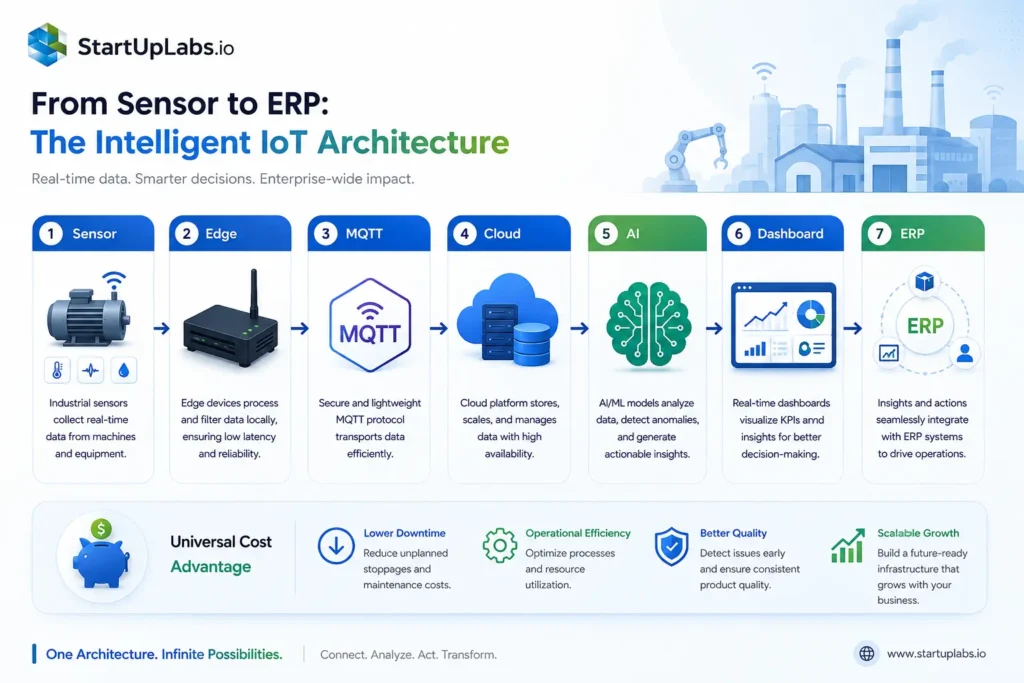
Typical flow:
Sensor → Edge → MQTT → Cloud → AI → Dashboard → ERP
Choose sensors, gateways, communication protocols, cloud infrastructure, databases, backend technologies, and frontend/mobile frameworks based on device requirements, scalability, latency, security, and budget.
Build the software required to communicate with and manage connected devices. This can include firmware, device provisioning, authentication, data ingestion, APIs, cloud services, device management, and business logic.
Develop web or mobile applications that convert IoT data into actionable information. Integrate the platform with systems such as ERP, CRM, WMS, analytics platforms, and maintenance software where required.
Secure every layer of the system through device authentication, encryption, access control, API security, and secure OTA updates. Test hardware, connectivity, APIs, performance, security, and real-world device behavior before production deployment.
After launch, monitor device health, data quality, system performance, and security. Scale infrastructure as the number of devices grows and continuously improve the platform through analytics, AI, firmware updates, and new business requirements.
The combination of artificial intelligence and IoT is commonly described as AIoT, or Artificial Intelligence of Things.
Traditional IoT primarily answers:
“What is happening?”
AI-enabled IoT can help answer:
“Why is it happening, what is likely to happen next, and what should we do?”
Predictive Maintenance
Machine learning models can analyze historical equipment data to identify patterns associated with potential failures.
Anomaly Detection
AI models can identify behavior that differs from normal operating patterns.
Demand Forecasting
IoT data combined with historical business information can support demand and resource forecasting.
Computer Vision + IoT
Cameras and computer vision systems can become part of connected industrial or retail environments.
Edge AI
Some AI workloads can run closer to devices rather than sending all raw data to the cloud.
This can be useful when:
AI can help move IoT systems from simple threshold-based automation toward more adaptive decision-making.
For example:
Sensor data → AI analysis → anomaly detection → risk score → automated workflow
For businesses looking to incorporate predictive analytics, machine learning, or intelligent automation into connected systems, AI Development can extend the capabilities of traditional IoT software.
The cost of custom IoT software development in 2026 typically ranges from $25,000 to $500,000+, depending on the complexity of the connected devices, firmware requirements, number of devices, cloud architecture, security, analytics, integrations, and AI capabilities.
Unlike a standard web or mobile application, an IoT solution often involves multiple technical layers—from sensors and embedded software to edge computing, cloud infrastructure, dashboards, and enterprise systems. As a result, there is no single fixed price for every IoT project.
For business planning, the following universal estimate can be used:
| IoT Solution Complexity | Estimated Cost (USD) | Typical Timeline | Suitable For |
|---|---|---|---|
| Basic IoT Solution | $25,000 – $50,000 | 3–4 months | Device monitoring, basic dashboards, single protocol |
| Medium-Complexity IoT | $60,000 – $130,000 | 5–8 months | Multiple devices, cloud backend, mobile/web apps, APIs |
| Advanced IoT Platform | $150,000 – $300,000 | 8–12 months | Multi-device ecosystem, advanced analytics, automation |
| Enterprise IoT Solution | $300,000 – $500,000+ | 12–18+ months | Large-scale deployments, AI, ERP/CRM integration, advanced security |
These figures are planning ranges rather than fixed quotations. A project can fall outside these ranges when it involves proprietary hardware, regulatory certification, large-scale deployments, highly specialized firmware, or complex AI/ML workloads.
Businesses that want to validate an IoT idea do not necessarily need to build the complete ecosystem from day one.
| Feature | IoT MVP | Advanced / Enterprise IoT |
|---|---|---|
| Estimated Cost | $25,000 – $55,000 | $150,000 – $500,000+ |
| Device Support | 1–2 device types | Multiple device types and protocols |
| Connectivity | Single primary protocol | Wi-Fi, BLE, LoRaWAN, cellular, etc. |
| Dashboard | Basic monitoring | Advanced real-time analytics |
| Analytics | Basic reporting | AI/ML and predictive analytics |
| Security | Standard authentication & encryption | Advanced device and infrastructure security |
| Cloud | Standard scalable infrastructure | Enterprise-grade distributed architecture |
| Integrations | 1–2 APIs | ERP, CRM, BI, WMS and other systems |
| Device Management | Basic provisioning | Full lifecycle and OTA management |
| AI | Optional | Predictive models, anomaly detection, automation |
Businesses can reduce unnecessary development costs by:
The goal should not be to build the cheapest IoT system. It should be to build the smallest reliable system that can validate the business case and scale appropriately.
The time required to build custom IoT software generally ranges from 3 to 12+ months, depending on the number of devices, hardware and firmware complexity, integrations, security requirements, analytics, and overall platform scope.
A practical timeline for most business IoT projects is:
| IoT Project Type | Typical Timeline | Scope |
|---|---|---|
| IoT Proof of Concept (PoC) | 4–8 weeks | Basic device connectivity, data collection, and technical validation |
| IoT MVP | 3–5 months | Devices, backend, cloud, dashboard, APIs, and basic device management |
| Mid-Scale IoT Platform | 5–8 months | Multiple devices, mobile/web apps, integrations, analytics, and security |
| Enterprise IoT Platform | 8–12+ months | Large device fleets, advanced security, AI/ML, edge computing, and ERP/CRM integrations |
| Complex Industrial IoT Ecosystem | 12–18+ months | Custom hardware/firmware, multiple protocols, real-time processing, AI, digital twins, and enterprise systems |
Different manufacturers may use different protocols and data formats.
Solution: Define integration standards and abstraction layers early.
Network Reliability
Solution: Build retry logic, local buffering, synchronization, and offline behavior into the architecture.
Thousands or millions of devices can generate significant telemetry.
Solution: Use appropriate ingestion pipelines, event processing, aggregation, and storage strategies.
Every connected device can become part of the security perimeter.
Solution: Use strong identity, authentication, encryption, secure updates, and lifecycle management.
Software problems can originate from hardware, firmware, networking, or cloud services.
Solution: Test the complete system rather than testing each layer in isolation.
A prototype architecture may not be appropriate for production scale.
Solution: Design ingestion, messaging, storage, and device management with future scale in mind.
Battery-powered devices may have strict energy limitations.
Solution: Optimize communication frequency, firmware behavior, sleep cycles, and edge processing.
A failed firmware update can potentially disrupt a device fleet.
Solution: Implement secure updates, version management, validation, staged rollouts, and rollback mechanisms.
Older ERP, CRM, or industrial systems may not have modern APIs.
Solution: Use integration middleware, adapters, APIs, or event-driven integration patterns where appropriate.
Consider a smart manufacturing platform designed to monitor industrial equipment.
The architecture could look like:
Here’s how the flow works.
1. Sensors Collect Data: Sensors collect temperature, vibration, pressure, speed, or other machine metrics.
2. Edge Gateway Processes Data: The gateway can filter abnormal readings and perform basic local processing.
3. Data Is Transmitted: Relevant information is sent through the selected communication protocol.
4. IoT Platform Ingests Data: The platform authenticates devices and receives telemetry.
5. Stream Processing Analyzes Events: Real-time processing can identify threshold violations or unusual patterns.
6. Historical Data Is Stored: Time-series storage can retain historical machine information.
7. AI Model Identifies Anomalies: A machine learning model can compare current behavior with historical patterns.
8. Dashboard Displays the Result: Operations teams can see machine status and potential risks.
9. Business Workflow Is Triggered: If a serious issue is detected, the system can create a maintenance workflow in an enterprise system.
This demonstrates an important principle:
The value of IoT is not the sensor itself. The value comes from what the software enables the business to understand and do with the data.
Custom software development for IoT is ultimately about connecting physical operations with digital intelligence.
Sensors can collect data, but data alone does not create business value. Businesses need software that can securely ingest that information, process it, analyze it, visualize it, integrate it with existing systems, and trigger meaningful actions.
Custom software development can be particularly valuable when an organization’s IoT requirements extend beyond the capabilities of a generic platform.
The strongest IoT projects begin with a clearly defined business problem and then work backward to determine the required hardware, connectivity, architecture, software, security, analytics, and integrations.
For businesses planning an IoT initiative in 2026, the objective should not simply be to connect more devices. It should be to build a reliable digital system that turns connected-device data into measurable operational, financial, or customer value.
If your business is evaluating a custom IoT platform, start by defining the devices, users, data, workflows, integrations, security requirements, and expected business outcomes. From there, an experienced software engineering team can determine the appropriate architecture and development roadmap.
Ans: Custom IoT software development is the process of building software specifically for connected devices, sensors, business workflows, data requirements, integrations, and operational needs. It can include device management, cloud infrastructure, APIs, dashboards, analytics, AI, security, and enterprise integrations.
Ans: IoT systems can use technologies such as C, C++, Rust, Python, Node.js, Java, Go, React, Flutter, PostgreSQL, MongoDB, InfluxDB, MQTT, CoAP, LoRaWAN, Wi-Fi, BLE, cellular connectivity, AWS, Azure, Google Cloud, and machine learning frameworks.
The appropriate stack depends on the project architecture.
Ans: IoT software is a broad term that can refer to applications and systems used to operate connected devices. An IoT platform generally provides infrastructure for capabilities such as device registration, communication, data ingestion, device management, and processing.
A business can build custom software on top of an existing IoT platform or develop a more customized IoT ecosystem.
Ans: Manufacturing, healthcare, logistics, retail, agriculture, automotive, energy, utilities, smart buildings, and other industries can use custom IoT software when connected devices can improve monitoring, automation, asset management, safety, efficiency, or decision-making.
Ans: Security depends on architecture and implementation. A secure IoT system should consider device identity, authentication, encryption, access control, secure firmware updates, API security, network segmentation, logging, monitoring, and vulnerability management.
Ans: Yes. Custom IoT software can integrate with ERP, CRM, warehouse management, maintenance, analytics, and other enterprise systems through APIs, middleware, event-driven architecture, or other integration mechanisms.
Ans: Yes. AI can be used for anomaly detection, predictive maintenance, forecasting, computer vision, classification, optimization, and intelligent automation. AI can run in the cloud, at the edge, or through a hybrid architecture depending on the use case.
Ans: There is no universally best cloud platform. AWS, Microsoft Azure, and Google Cloud all provide infrastructure and services that can support IoT architectures. The best choice depends on existing infrastructure, device requirements, security, data architecture, integrations, cost, and engineering expertise.
Ans: Businesses should consider an existing platform when requirements are relatively standard and rapid deployment is important. Custom development may be more appropriate when the business has specialized devices, workflows, integrations, security requirements, or a connected product that requires differentiated functionality.

The StartUpLabs Team consists of technology and digital marketing experts passionate about helping businesses grow. We share industry insights and best practices in software development, AI, web and mobile solutions, and digital marketing.
Get Quote Now
Recent Post