
When planning a mobile app, one of the biggest decisions you’ll face is choosing the right development approach. Should you go with native apps, cross-platform apps, or hybrid apps?
This choice directly impacts your app’s performance, cost, scalability, and time to market. And honestly, there’s no one-size-fits-all answer—it depends on your business goals.
If you’re still understanding the basics, you can first explore what mobile app development is to get foundational clarity before diving into this comparison.
Quick Answer:
If you’re looking for a quick recommendation:
The right choice depends on your users, budget, business objectives, and long-term product roadmap.
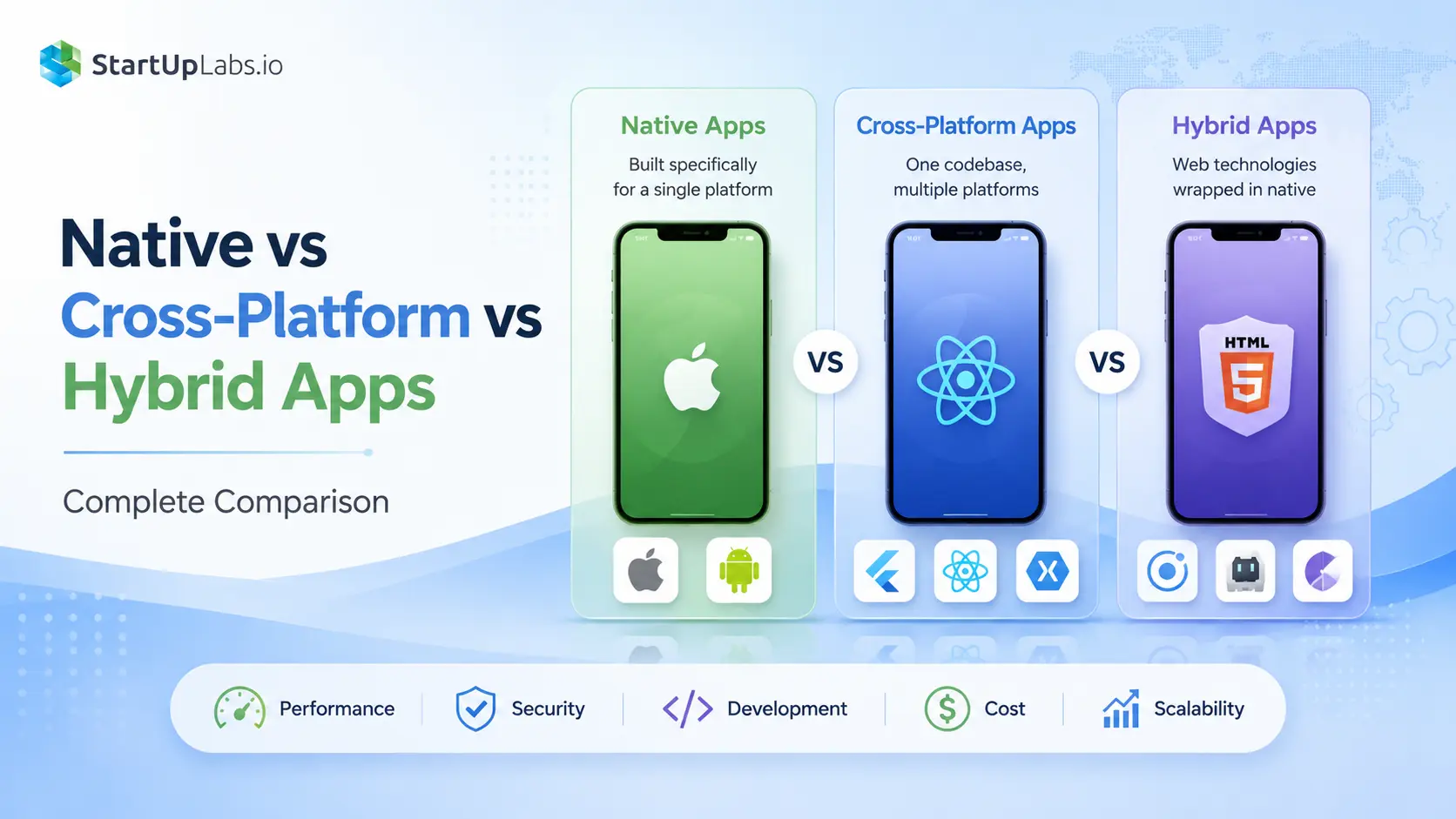
Mobile apps are generally categorized into three main types:
Each type uses different technologies and development approaches. Understanding these differences helps you make better business decisions.
Choosing the right app architecture affects development cost, launch speed, scalability, security, maintenance effort, user experience, and future feature expansion. Making the wrong decision often leads to expensive redevelopment later.
For a broader overview of mobile app strategies, you can also refer to the complete guide to mobile app development in 2026
Not all mobile apps are built the same way. Before a single line of code gets written, one of the most important decisions a business makes is what kind of app to build. Each approach comes with its own tradeoffs on cost, speed, performance, and reach.
A native app is developed specifically for a single operating system. iOS applications are built using Swift, while Android applications use Kotlin. Since native apps are designed exclusively for one platform, they can fully leverage the operating system, hardware, and platform-specific capabilities.
Native apps provide the fastest startup time, smoother animations, better battery efficiency, stronger offline capabilities, and full access to device APIs such as biometrics, NFC, Bluetooth, GPS, camera, and background services. They are ideal for banking, healthcare, fintech, gaming, AI-powered experiences, and enterprise applications where performance and security are critical.
Key Features of Native Apps:
Businesses that prioritize performance often invest in iOS app development or Android app development services to build fully optimized apps.
Cross-platform apps are built using a single codebase that works across multiple platforms like iOS and Android.
Modern frameworks such as Flutter and React Native have significantly narrowed the performance gap with native development. Cross-platform development enables faster releases, shared business logic, simplified maintenance, and lower long-term costs, making it an excellent choice for startups, SaaS platforms, marketplaces, and ecommerce applications.
Instead of maintaining separate Android and iOS projects, developers write the core application once while making only small platform-specific adjustments when necessary.
Key Features of Cross-Platform Apps:
Startups and businesses with limited budgets often choose cross-platform app development services to launch faster.
Hybrid apps typically use HTML, CSS, and JavaScript inside a native container. They are suitable for content-driven apps, event apps, employee portals, and rapid MVP validation. However, complex animations, intensive graphics, and advanced hardware integrations may expose performance limitations.
Instead of building a completely native interface, hybrid applications render much of their content through web technologies while still being distributed through app stores.
Hybrid development focuses primarily on rapid delivery and lower development costs.
Key Features of Hybrid Apps:
Hybrid apps are often used for simpler applications or MVPs.
| Feature | Native Apps | Cross-Platform Apps | Hybrid Apps |
|---|---|---|---|
| Performance | Excellent | Very Good | Moderate |
| Development Cost | High | Medium | Low |
| Development Time | 4–8 Months | 3–6 Months | 2–4 Months |
| User Experience | Excellent | Very Good | Good |
| Security | Excellent | Very Good | Good |
| Offline Support | Excellent | Excellent | Moderate |
| Hardware Access | Full Access | Nearly Full | Limited |
| Code Reusability | Low | High | High |
| Maintenance | Complex | Easy | Easy |
| Scalability | Excellent | Very Good | Moderate |
| Best For | Enterprise, Banking, Gaming | Startups, SaaS, Marketplaces | MVPs, Internal Apps |
| Development Type | Estimated Development Cost | Best For |
|---|---|---|
| Native Apps | High | Enterprise apps, Banking, Gaming, Healthcare |
| Cross-Platform Apps | Medium | Startups, SaaS, eCommerce, Marketplaces |
| Hybrid Apps | Low | MVPs, Internal Business Apps, Event Apps |
| Development Type | Estimated Timeline |
|---|---|
| Native Apps | 4–8 Months |
| Cross-Platform Apps | 3–6 Months |
| Hybrid Apps | 2–4 Months |
There isn’t a single mobile app development approach that’s right for every project. The best choice depends on your business goals, budget, target audience, performance requirements, and long-term growth plans. Instead of asking “Which technology is the best?”, ask “Which technology is best suited for my business?”
Native app development is the right choice when performance, security, and premium user experience are your top priorities.
Choose native apps if you are building:
Although native development requires a higher investment, it delivers the best long-term performance, scalability, and reliability.
Cross-platform development is ideal for businesses looking to launch on both Android and iOS while reducing development costs and maintenance effort.
Choose cross-platform apps if you:
Modern frameworks like Flutter and React Native provide near-native performance, making cross-platform development a practical choice for many startups and growing businesses.
Hybrid development works best for projects where rapid development and affordability are more important than maximum performance.
Hybrid apps are suitable for:
However, if your application requires intensive graphics, real-time communication, or advanced hardware features, native or cross-platform development will usually provide better long-term results.
For enterprise-level solutions, companies often prefer custom mobile app development through expert teams to ensure long-term scalability.
Choosing the wrong approach can lead to:
That’s why businesses rely on expert mobile app development services to guide them through the decision-making process.
Choosing the wrong architecture can become expensive later. Avoid these common mistakes:
Building Native Too Early
Many startups invest heavily in native apps before validating product-market fit. Launching an MVP first often reduces risk.
Choosing Hybrid for High-Performance Apps
Hybrid architecture isn’t ideal for:
Performance limitations become more noticeable as applications grow.
Ignoring Future Scalability
Choosing technology based only on today’s requirements often results in expensive redevelopment later.
Think about where your business will be in three to five years.
Focusing Only on Initial Cost
The cheapest solution today isn’t always the most affordable over the product’s lifetime.
Maintenance, scalability, and future enhancements should influence your decision.
Artificial Intelligence is changing how modern mobile applications are built.
Businesses increasingly expect features such as:
Native applications provide the deepest integration with device hardware for advanced AI experiences.
However, modern cross-platform frameworks now support most AI SDKs and cloud-based AI services, making them an excellent option for many business applications.
For companies planning AI-powered products, choosing an architecture that supports future AI integration is just as important as current performance requirements.
Choosing between native, cross-platform, and hybrid development isn’t about finding a universally superior technology—it’s about selecting the architecture that best supports your business objectives.
If your application demands maximum performance, enterprise-grade security, and the best possible user experience, native development remains the gold standard.
If you’re looking for faster development, lower costs, and excellent cross-platform compatibility, modern cross-platform frameworks offer an outstanding balance of quality and efficiency.
If your goal is to launch an MVP, validate an idea quickly, or build a lightweight business application, hybrid development can still be a practical choice.
The most successful mobile applications are built on technology decisions that align with business strategy rather than trends. Evaluating your budget, timeline, scalability needs, security requirements, and long-term vision before development begins can save significant time and cost in the future.
Whether you’re building your first app or scaling an existing digital product, partnering with an experienced mobile app development team helps ensure you choose the right architecture from day one and build a solution that supports your business for years to come.
Ans:The three primary types are native apps, cross-platform apps, and hybrid apps. Each uses a different development approach and offers unique advantages depending on performance, cost, and business requirements.
Ans:Native apps provide the highest performance and deepest hardware integration. Cross-platform apps offer faster development and lower costs while delivering excellent performance for most business applications.
Ans: No. Hybrid development is still useful for internal tools, informational apps, and MVPs. However, it is generally not recommended for complex, high-performance applications.
Ans:Most startups choose cross-platform development because it allows them to launch on Android and iOS faster while keeping development costs under control.
Ans:Hybrid development usually has the lowest initial cost, followed by cross-platform development. Native development generally requires the highest investment due to separate platform-specific codebases.
Ans: Native applications provide the highest performance, fastest response times, and smoothest user experience because they are built specifically for one operating system.
Ans: Native development provides the deepest integration with device hardware for advanced AI capabilities, while modern cross-platform frameworks also support most AI SDKs and cloud-based AI services.

The StartUpLabs Team consists of technology and digital marketing experts passionate about helping businesses grow. We share industry insights and best practices in software development, AI, web and mobile solutions, and digital marketing.

Get Quote Now
Recent Post