Businesses increasingly depend on technology to run operations, serve customers, manage data, and launch new products. Yet many organizations still rely on legacy systems that were built years or even decades ago. These systems may continue to support critical business processes, but they can become increasingly expensive, difficult to maintain, harder to integrate, and less capable of supporting modern digital initiatives.
Legacy system modernization is the process of updating, transforming, migrating, or replacing outdated technology so it can better support current and future business requirements. Modernization can improve scalability, security, performance, integration, and operational efficiency without necessarily requiring a complete replacement of the existing system.
For businesses planning digital transformation, the question is no longer simply whether legacy technology should be modernized, but which systems should be modernized, which approach should be used, and how the transition can be managed with minimal business disruption.
Legacy system modernization refers to the process of improving older applications, software, databases, infrastructure, or technology architectures so they can meet modern business and technical requirements.
A legacy system may include an aging enterprise application, an on-premises database, a monolithic application, unsupported software, outdated programming languages, or systems that were designed before APIs, cloud computing, mobile applications, and modern analytics became common.
Modernization does not always mean replacing the entire system. Depending on the situation, a business may:
The objective is to reduce technology constraints while preserving the business capabilities that still deliver value.
Modernization is usually driven by a combination of business, technical, operational, and security requirements. A system that once provided a competitive advantage can eventually become a barrier to growth.
Older systems may depend on unsupported operating systems, outdated software components, or architectures that are difficult to patch and monitor.
This does not mean every legacy system is inherently insecure. However, older environments can create additional security and compliance challenges when organizations cannot easily apply patches, modern authentication methods, monitoring capabilities, or updated controls.
Modernization can help businesses introduce stronger security practices while creating a technology environment that is easier to maintain and govern.
Legacy systems are often designed around older usage patterns and infrastructure assumptions. When transaction volumes, users, locations, or data requirements increase, these systems may struggle to scale efficiently.
A modernized architecture can provide greater flexibility for handling changing workloads and supporting business expansion.
Modern businesses rarely operate with one application. They rely on cloud platforms, SaaS products, mobile applications, payment systems, analytics platforms, CRM systems, automation tools, and other services.
Legacy systems may not provide modern APIs or integration capabilities, forcing teams to build workarounds or rely on manual processes.
Modernization can expose legacy functionality through APIs and enable software integration services that connect older platforms with cloud applications, SaaS tools, and modern digital products.
When a simple feature change requires extensive modification to an old codebase, product development can become slow and expensive.
Development teams may spend more time understanding dependencies and preventing regressions than delivering new functionality. Modernization can simplify the architecture and enable teams to release improvements more efficiently.
Technology problems are not always visible as “technology problems” to customers. Slow applications, unreliable services, inconsistent interfaces, and limited digital capabilities ultimately affect customer experience.
Modernizing back-end systems can create a stronger foundation for faster applications, improved reliability, modern digital channels, and more responsive customer services.
Not every older system needs immediate modernization. Some systems remain stable, secure, and valuable for years. The decision should be based on business impact and technical risk rather than age alone.
Common warning signs include:
When several of these issues occur at the same time, a formal modernization assessment can help determine the most practical path forward.
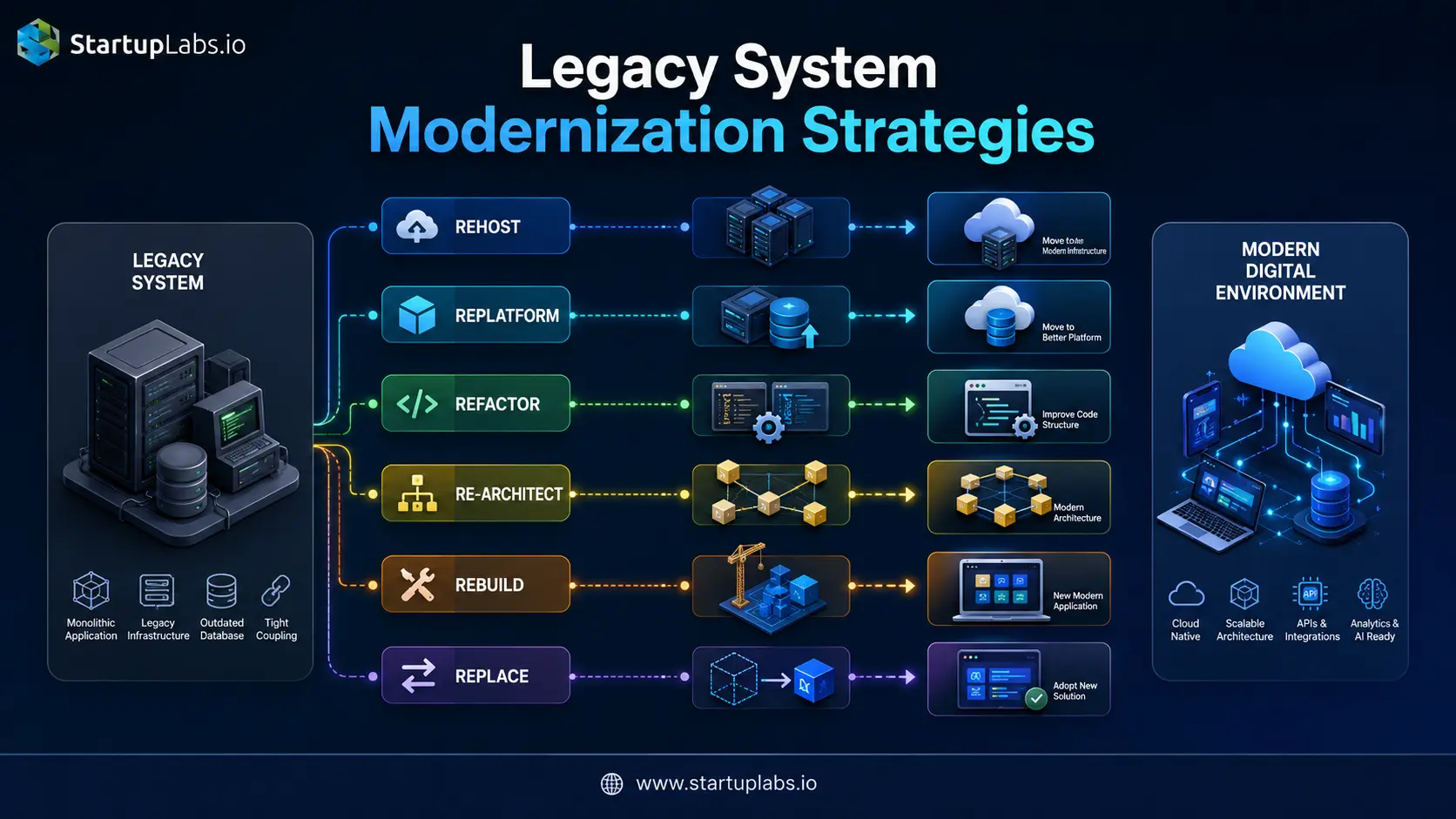
There is no single modernization strategy that works for every organization. The right approach depends on system complexity, business criticality, risk, budget, timeline, and long-term technology goals.
Rehosting, often described as “lift and shift,” moves an application to a new infrastructure environment with limited changes to the application itself.
Best for: Organizations that need a relatively fast infrastructure transition.
Trade-off: It can improve infrastructure flexibility without solving deeper application or architectural limitations.
Replatforming moves the application to a newer platform while making selected improvements.
Best for: Businesses that want better performance or cloud capabilities without completely redesigning the application.
Trade-off: More work is required than rehosting, but the system may still retain some legacy limitations.
Refactoring restructures or improves the existing code without fundamentally changing the application’s core behavior.
Best for: Applications that remain valuable but have become difficult to maintain.
Trade-off: Development effort can be significant, especially when legacy code has limited documentation or extensive dependencies.
Re-architecting changes the underlying architecture to improve scalability, maintainability, integration, or resilience.
Best for: Systems whose existing architecture prevents future growth.
Trade-off: It requires more planning, technical expertise, testing, and investment.
Rebuilding means creating a new application that replaces the core functionality of the existing system.
Best for: Systems that are too difficult or costly to modernize incrementally.
Trade-off: It can involve significant development time, migration complexity, and transition risk.
Replacing means adopting a new commercial or custom solution instead of continuing to evolve the existing system.
Best for: Applications that no longer align with business requirements or can be better served by a modern alternative.
Trade-off: Replacing a system can require major data migration, process changes, integration work, and user training.
The key takeaway is simple: modernization should be treated as a business decision, not just a technology decision.
A well-planned modernization program can deliver benefits across technology and business operations.
Lower Total Cost of Ownership
Modern platforms and architectures can reduce infrastructure overhead, maintenance complexity, and dependence on specialized legacy skills.
Better Security and Compliance
Modernized systems are generally easier to patch, monitor, secure, and integrate with current identity and security controls.
Improved Performance and Reliability
Updating architecture, infrastructure, and application components can improve response times, reliability, availability, and operational stability.
Greater Scalability and Flexibility
Modern systems can be designed to accommodate changing workloads, new users, additional locations, and evolving business requirements.
Faster Product Development
A cleaner architecture and more maintainable codebase can reduce development friction and help teams introduce features faster.
Easier Integration
APIs, event-driven architectures, integration platforms, and modern data services can connect legacy business capabilities with new digital applications.
Better Data Accessibility
Modernized data platforms can make business information easier to access, govern, analyze, and use across departments.
Greater Readiness for AI and Automation
AI and automation initiatives depend on accessible, reliable, and well-governed systems and data. Modernization can create the technical foundation required to connect those capabilities to business workflows.
A successful modernization program should follow a structured process rather than beginning with technology replacement.
1. Assess the Existing System
Start by documenting applications, databases, infrastructure, integrations, dependencies, data flows, and business-critical functions.
2. Define Business and Technical Goals
Decide what modernization needs to achieve. Goals might include reducing costs, improving security, moving to the cloud, increasing scalability, enabling APIs, or supporting new digital products.
3. Prioritize Applications and Components
Not every system requires the same level of investment. Prioritize based on business criticality, technical complexity, risk, modernization value, and future requirements.
4. Select the Right Modernization Strategy
Determine whether each component should be rehosted, replatformed, refactored, re-architected, rebuilt, or replaced.
5. Modernize, Migrate, and Test
Execute the technical transition while carefully validating data, integrations, functionality, security, performance, and user workflows.
6. Deploy and Continuously Optimize
After implementation, monitor the new environment, address performance issues, update documentation, train users, and continue improving the system based on business needs.
A phased approach is often preferable for business-critical systems because it can reduce disruption and make risks easier to manage.
Modernization can deliver substantial value, but it also introduces risks that need to be actively managed.
Data migration complexity: Old systems may contain inconsistent, duplicated, or undocumented data structures.
Hidden dependencies: A legacy application may interact with systems that are poorly documented or only understood by a small number of employees.
Business disruption: Critical applications cannot simply be switched off without affecting operations.
Cost and resource requirements: Modernization requires technical expertise, planning, testing, and change management.
Resistance to change: Employees may be comfortable with existing processes and reluctant to adopt new workflows.
Security during migration: Data and applications must remain protected throughout the transition.
Successful modernization programs address these risks during the planning stage rather than after implementation begins.
There is no universal price for legacy system modernization because the scope varies significantly from one organization to another.
Costs depend on factors such as:
Organizations should evaluate modernization cost alongside the long-term cost of retaining the existing system. In some cases, delaying modernization can increase technical debt, operational costs, and business risk.
Modernization and replacement are not always opposites.
Modernization typically focuses on improving an existing system while preserving valuable business functionality.
Replacement introduces a new system that takes over from the old one.
A business may modernize some components, replace others, and retain systems that continue to perform well. This hybrid strategy is often more practical than attempting to transform every application simultaneously.
The goal should be to create the right technology environment for the business, not to modernize technology simply because it is old.
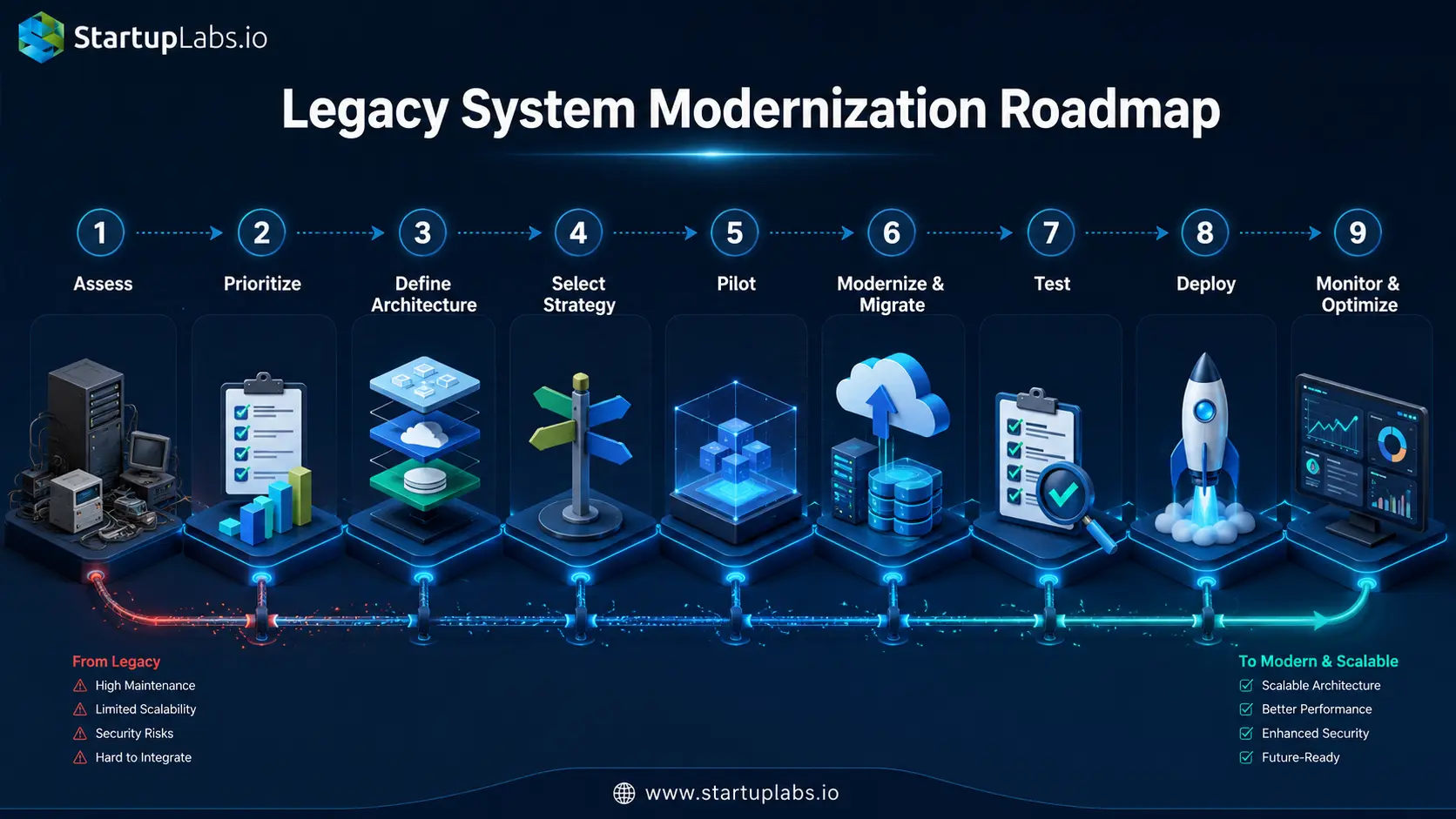
A modernization roadmap provides a structured path from assessment to implementation.
A practical roadmap can follow this sequence:
Assess → Prioritize → Define Architecture → Select Strategy → Pilot → Modernize/Migrate → Test → Deploy → Monitor → Optimize
The roadmap should balance three dimensions:
Business: objectives, ROI, priorities, timelines, and operational impact.
Technology: architecture, code, infrastructure, integrations, data, and security.
People: technical skills, stakeholder alignment, training, communication, and change management.
Starting with a high-value but manageable pilot can help validate the modernization approach before expanding it across a larger portfolio.
Modernization is increasingly connected to broader digital transformation initiatives.
Cloud: Cloud platforms can provide flexible infrastructure, managed services, and deployment options that are difficult to achieve with some aging environments.
APIs: APIs can expose legacy capabilities to modern applications without requiring the entire underlying system to be replaced immediately.
AI and automation: AI can support areas such as customer service, document processing, forecasting, and operational automation. However, successful AI adoption also depends on data quality, governance, security, and system accessibility.
For organizations evaluating these opportunities, AI development services can help connect AI capabilities with existing business processes and applications. StartupLabs positions its AI services around intelligent, scalable systems, AI integration, automation, and decision support.
Modernization therefore provides more than a technical upgrade. It can create the foundation needed for future digital capabilities.
Legacy systems can remain valuable long after the technology used to build them becomes outdated. The challenge is knowing when an existing system has shifted from being a business asset to becoming a constraint on growth.
Legacy system modernization gives businesses a way to reduce technical debt, improve security and scalability, simplify integration, increase development agility, and prepare their technology environment for future capabilities.
The most effective modernization strategy is rarely about replacing everything at once. Instead, businesses should assess their current environment, identify the systems creating the greatest risks or limitations, select the right modernization approach, and execute the transformation in manageable phases.
Modernization is ultimately not about having newer technology. It is about creating technology that enables the business to move faster, operate more efficiently, and adapt to what comes next.
Ans: Legacy system modernization is the process of updating, transforming, migrating, or replacing outdated software, applications, data systems, or infrastructure to meet modern business and technical requirements.
Ans: It can help businesses address rising maintenance costs, security risks, scalability limitations, integration challenges, slow development cycles, and technology constraints that affect growth.
Ans: The main strategies include rehosting, replatforming, refactoring, re-architecting, rebuilding, and replacing the legacy system.
Ans: The timeline depends on the number of applications, system complexity, migration requirements, integrations, testing scope, and modernization strategy. Small application improvements may take considerably less time than enterprise-wide transformation programs.
Ans: A typical legacy system modernization project can cost anywhere from $20,000 to $500,000+, depending on the application’s complexity, number of systems involved, data migration requirements, integrations, infrastructure, security, and modernization approach. Smaller application modernization projects may fall near the lower end, while enterprise-wide modernization programs can exceed $500,000.
Ans: Yes. Many organizations modernize legacy systems incrementally through refactoring, replatforming, API integration, infrastructure upgrades, or architectural improvements while continuing to use existing business functionality.
Ans: Common risks include data migration problems, hidden dependencies, integration failures, cost overruns, business disruption, security issues, and resistance to organizational change.

The StartUpLabs Team consists of technology and digital marketing experts passionate about helping businesses grow. We share industry insights and best practices in software development, AI, web and mobile solutions, and digital marketing.
Get Quote Now
Recent Post